- Home
- About us
- Products
- Faqs
- Enterprise FAQ
- Product FAQ
- Service FAQ
- Custom FAQ
- Production, Craftsmanship & QC
- Pricing & Payment Terms
- Logistics, Lead Time & Supply Chain
- Brand Collaboration & Case Study
- Small Batch & Flexible Production
- Collection FAQ
- Knowledge FAQ--Hybrid Training Wear
- Knowledge FAQ--Training Shorts Collection
- HUCAI activewear Homepage FAQ
- News
- Certificate
- Contact us
Custom Logo Athleticwear: Why Logos Fail in Motion, Not in Samples
time2026/01/27
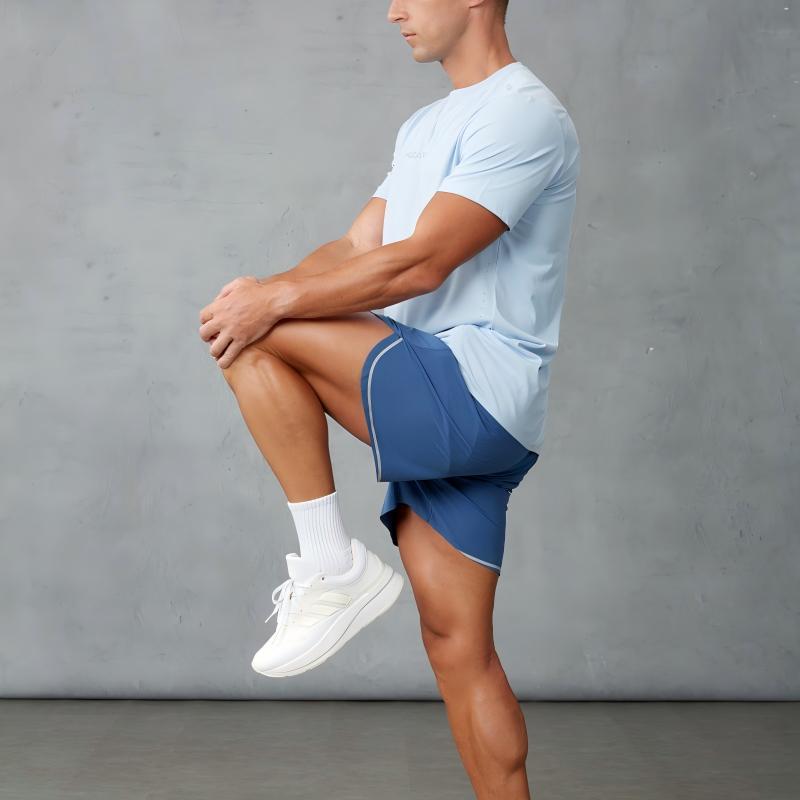
- In custom logo athleticwear, logos fail under movement—where fabric behavior, structure, and motion interact beyond static testing.
Logos Rarely Break Where Brands Look First
In samples, logos almost always behave.
They appear centered. They feel correct to the touch. They photograph cleanly.
This is not accidental. In static conditions, logos exist in isolation. Fabric is relaxed. Structure is inactive. Gravity is predictable. The logo is evaluated as a surface feature, not a system participant.
Most approval processes stop here.
What follows in real use is a different environment entirely—one where the logo is no longer alone.
The Moment a Logo Enters Motion, It Enters the System
Once worn, a logo stops being graphic and starts behaving like material.
It stretches with the fabric, but not always in the same direction. It resists recovery differently than the textile beneath it. It becomes an anchor point for visual attention while the garment is under tension.
During movement, the logo is pulled by forces it was never tested against in static review. Fabric stretch paths shift. Construction zones activate. Body mechanics introduce asymmetry.
In this state, even minor variations—slightly different recovery curves between fabric batches, subtle changes in seam tension, marginal shifts in placement—compound. The logo begins to distort, harden, lift, or visually drift.
Nothing has “failed” in the traditional sense. The system has simply entered a state it was never calibrated for.
Why Mature Brands Encounter This Problem First
This issue rarely affects early-stage brands.
Large, high-contrast logos tolerate distortion. Visual noise hides inconsistency. Movement masks error.
Mature brands operate differently. Logos become quieter. Smaller. Integrated. Often tonal. Their value lies in restraint.
That restraint reduces tolerance.
In these products, the logo is no longer decoration—it is a precision element. Its stability depends on how well the manufacturing system synchronizes fabric behavior, construction logic, and motion response.
This is why custom logo athleticwear challenges appear after success, not before.
At HUCAI, logos are treated as dynamic variables during development. Placement, bonding method, and interaction with fabric stretch directions are evaluated under simulated movement—not just visual inspection—so stability is engineered before scale exposes weakness.
This is not a branding upgrade. It is a system requirement.
The Question Brands Should Be Asking
Instead of asking whether a logo looks correct on the table, ask this:
What does this logo do when the garment is no longer still?
If the answer is unknown, manufacturing will discover it later—at scale.
Custom logo athleticwear does not fail because logos are complex. It fails because motion reveals whether the system was ever designed to hold them.
Thank you for reading.
To explore how motion-aware manufacturing supports stable custom logo athleticwear, visit https://..........com/.